
For many young people, nature is not part of everyday life.
Busy school timetables, screen time, cost pressures, transport barriers and unequal access to safe green space all mean that too many children and young people are growing up without regular opportunities to spend time outdoors. Yet the evidence is increasingly clear: time in nature is not a “nice to have”. It is vital for children’s wellbeing, confidence, learning and future opportunity.
At a time when young people are facing growing pressures on their mental health, and when the UK needs to build the skills and confidence required for a greener future, access to nature matters more than ever.
WELLBEING
Nature supports mental health and wellbeing
Spending time outdoors can give young people something increasingly rare: space to breathe, move, explore, reflect and connect.
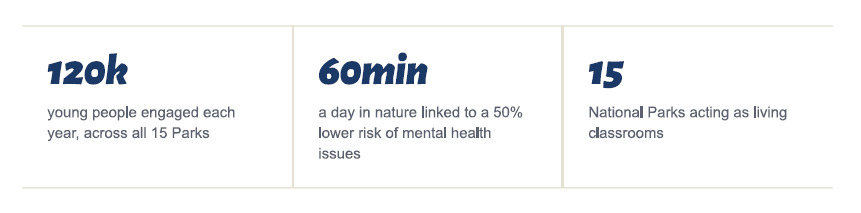
Research led by the University of Glasgow found that children who spent more time in natural environments had significantly better mental health, with the strongest benefits seen for children from lower-income households.

This matters because access to nature is not equal. Young people from disadvantaged communities often face the greatest barriers to green space, but may also stand to benefit the most. When nature is accessible, safe and supported by trusted adults, it can help reduce inequalities, build social connection and give young people a positive experience of the world around them.
Outdoor learning also supports confidence, resilience and self-esteem. Young people learn to take manageable risks, work together, solve problems, communicate and navigate unfamiliar environments. These are not just outdoor skills. They are life skills.
LEARNING
Outdoor learning helps young people thrive
Nature is also a powerful place to learn.
Outdoor learning can make subjects feel real, practical and relevant. It can enrich the curriculum, deepen children’s connection to nature and support health and wellbeing. It can bring climate change, biodiversity, geography, science, farming and heritage to life in a way that classroom learning alone cannot. Outdoor play can also develop communication, teamwork, creativity and problem-solving skills.
For some young people, especially those who struggle in a traditional classroom, learning outdoors can be transformative. The shift in environment can reduce pressure, increase confidence and help young people demonstrate abilities that may not always be visible indoors.

Natural England has also highlighted the importance of integrating nature into the school day, pointing to evidence that children who spend time outside connecting with nature can see improvements in school attendance, behaviour, academic achievement and social skills such as teamwork.
In other words, time in nature supports the whole young person: their wellbeing, their learning, their relationships and their sense of what may be possible.
GREEN SKILLS
The future green economy starts with nature connection
If we want young people to care for nature, work in the green economy and help shape a more sustainable future, they first need the chance to experience and understand the natural world.
Green skills do not begin only with technical training. They often begin with curiosity. With a first visit to a National Park. With a school trip that would not otherwise have happened without external funding. With a young person discovering peatland restoration, wildlife surveying, woodland management and sustainable farming for the first time.
The UK’s green economy will need people with a wide range of skills: ecologists, rangers, land managers, engineers, planners, data specialists, educators, communicators, entrepreneurs and leaders. But it will also need people who understand the value of nature, the importance of place and the role healthy landscapes play in a resilient future.
That is where the UK’s National Parks have a unique role to play.
LIVING CLASSROOMS
National Parks are living classrooms

The UK’s 15 National Parks are some of the country’s most iconic landscapes. But they are also living, working places where nature, communities, heritage and local economies come together. They provide powerful settings for young people to learn in and from nature.
Across the National Parks, learning and engagement teams already work with schools, youth groups and communities to connect young people with the natural world through hands-on experiences, outdoor education, volunteering, residentials, youth ranger programmes and green skills activities.
These programmes can help young people build confidence, develop practical skills, improve wellbeing and understand the role they can play in protecting and restoring nature. They also help remove barriers for young people who may otherwise miss out, including those from under-represented communities, urban areas and families facing financial pressures.
National Parks are uniquely placed to do this because they combine inspiring landscapes with trusted local delivery, expert knowledge and long-term stewardship.
They are places where young people can see nature recovery happening in real time. They can meet the people who care for these landscapes. They can learn how land, water, wildlife, climate and communities are connected. And they can begin to see themselves as part of that future.
THE PROGRAMME
Green Futures: scaling opportunity for the next generation
National Parks Green Futures is designed to help more young people access these opportunities.
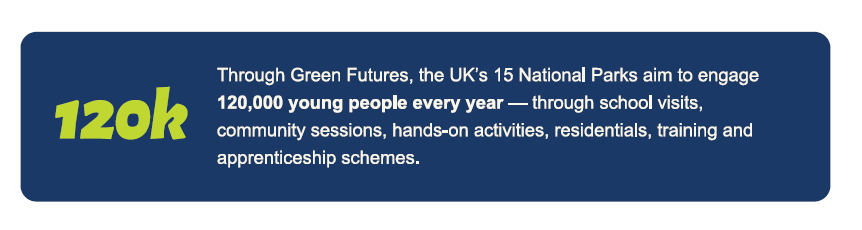
The aim is simple: to help young people connect with nature, build confidence and develop the green skills they need for the future.
For businesses, Green Futures offers a credible and measurable way to support youth opportunity, wellbeing, green skills and nature connection. It turns sustainability and social value commitments into practical action for the next generation.
That support can help fund the learning activities we know make a difference: transport bursaries, outdoor learning visits, youth ranger schemes, community sessions, green careers days, residential experiences, practical conservation activities and training pathways.
THE OPPORTUNITY
Every young person deserves access to nature
Time in nature should not depend on postcode, household income, transport, confidence or whether a school can afford a coach. Every young person should have the chance to experience the natural world, understand why it matters, and see a place for themselves in a greener future.
For some, that first experience may improve confidence or wellbeing. For others, it may open up a pathway into a future career. For many, it may simply create a lasting connection with nature that stays with them for life. That is why Green Futures matters.
The next generation will inherit the ongoing challenges of climate change, nature loss and the transition to a greener economy. They will need knowledge, resilience, confidence and hope. National Parks can help provide that. But we cannot do it alone.
By partnering with National Parks Green Futures, businesses can help young people access nature, build green skills and shape a more sustainable future. The opportunity is clear: support young people today, and help grow the nature advocates, green workers and future leaders of tomorrow.
Sources
This article draws on evidence and insight from: Learning through Landscapes, “Attainment: the impacts of outdoor learning and play” (accessed 2026); University of Glasgow, “Nature time boosts children’s mental health, especially in low-income families” (2024); UK Youth, “Outdoor learning is vital for children’s mental health” (2024); and Natural England, “Children & Nature Programme: the importance of integrating time spent in nature at school” (2023).