
On 29 July 2026, the Environment Agency declared a drought across more than half of England, the third time this has happened in five years.
Seven regions, from East Anglia to Devon and Cornwall, are officially in drought. More than 20 million people are living under hosepipe bans. Rivers are running at record lows, farmers are harvesting early, and wildfires are burning across protected sites, including in the UK’s National Parks.
This is not a freak event. It is part of a pattern scientists now call “climate whiplash” and it is becoming the new baseline for how Britain experiences water. For any business that depends on a stable water supply, resilient supply chains, or the wellbeing of the communities and landscapes it operates in, that should be a board-level concern. It is also, increasingly, an opportunity to invest in solutions that work and the UK’s National Parks are on the front line of delivering them.
A flash drought, and a warning from the experts
What makes 2026 unusual is not just the severity of the drought but the speed at which it arrived. A wet January and February topped up reservoirs and groundwater; then the taps, in effect, turned off. July has seen just 7% of average rainfall across England, only 1% across the south, with parts of Devon and Hampshire going more than a month without rain.
Helen Wakeham, Director of Water at the Environment Agency and Chair of the National Drought Group, put it plainly:
“The hot and dry weather means we are currently using water faster than nature can replenish it. A second consecutive summer drought is an exceptionally serious situation and one that will have long-lasting impacts on our environment, wildlife, and the economy.”
Professor Hayley Fowler of Newcastle University was direct about the underlying cause:
“This drought isn’t just about a lack of rain. It’s the result of hotter temperatures from a warming climate, rising water demand, ageing infrastructure and too much water being lost through leaks.”
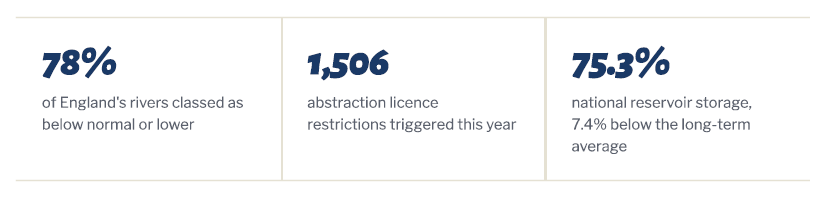
The Environment Agency has separately warned that, without urgent action, England’s public water supplies could face a shortfall of five billion litres a day by the middle of the century. Reservoir storage nationally now sits at 75.3%, around 7.4% below the long-term average for this time of year.
The cost is already being felt, and it isn’t only environmental
Drought’s impacts move quickly from rivers and reservoirs into the wider economy. Some 78% of England’s rivers are now classed as below normal or lower. Atlantic salmon can’t move upstream. For agriculture, the picture is stark.
Paul Tompkins, Deputy President of the National Farmers’ Union of England and Wales, described what this means on the ground:
“Farmers and growers have always had to contend with the weather, but what they are experiencing now is climate change in action. More extreme conditions are making it harder, riskier and more costly to produce the nation’s food.”
— Paul Tompkins, NFU
He added that drought “should matter to everyone” because it is now a question of national food security. Low river flows have triggered 1,506 abstraction licence restrictions this year, and early harvesting and reduced yields are already showing up in supply chains. For water-intensive businesses — food and drink, manufacturing, construction, tourism, insurance, retail — this is a direct operational risk. For everyone else, it’s a systemic one: water scarcity strains the infrastructure, ecosystems and communities that underpin the wider economy in which every business operates.
Water Minister Emma Hardy was candid about the scale of the response required:
“Our climate is changing, droughts are becoming increasingly common, and we need to be prepared for this new normal. We’re delivering long-term change in the water industry and driving record investments in infrastructure, including nine new reservoirs.”
— Emma Hardy MP, Water Minister
New reservoirs and fixed leaks are essential. But they are not sufficient on their own and this is where nature, and the National Parks that steward 10% of the land, become central to the answer.
Nature-based solutions: the evidence base is growing
A 2026 research briefing from the Parliamentary Office of Science and Technology (POST) sets out why nature-based solutions are now a strategic government priority for flood and drought resilience. POST defines them, following the IUCN standard, as:
“Actions to protect, sustainably manage and restore natural and modified ecosystems in ways that address societal challenges effectively and adaptively, to provide both human wellbeing and biodiversity benefits.”
— POSTnote PN-0768, UK Parliament
In practice, that means peatland restoration, wetland restoration, tree planting, better land and soil management, and floodplain reconnection. The evidence POST reviewed shows these interventions can slow surface run-off, increase the soil’s capacity to absorb water, and — critically for drought — help groundwater stores recharge faster during dry periods.
The Environment Agency’s own position is unambiguous: nature-based solutions “increase resilience to flood, drought and climate change while providing benefits to nature and society.” But POST’s briefing is equally honest about the barriers: funding for nature-based solutions is often short-term and fragmented, long-term monitoring is difficult and expensive, and most existing projects have been built site-by-site rather than at the catchment scale where they deliver the most value. Closing that gap — funding nature-based solutions at landscape scale, with the monitoring rigour to prove what works — is precisely the space in which National Parks, with the scale, ecological expertise and existing land relationships, are best placed to operate.
Why the National Parks are the delivery mechanism this problem needs
Much of the UK’s National Parks sit in the uplands and headwaters of major river catchments, the point where rainfall first hits the ground, well before it reaches the towns, farms and businesses downstream. That position matters: slowing and storing water at the top of a catchment, through peatland, woodland and soil restoration, reduces the peaks of both flood and drought further down the system. It’s a natural complement to the catchment-based approach that POST and the Environment Agency are calling for, and one that plays specifically to what National Parks are placed to deliver.

National Parks Partnerships’ Nature-based Solutions team works across all 15 National Parks, helping partners match their own business resilience needs to nature-based solutions that fit the landscape. The rationale is simple: healthy ecosystems regulate water, stabilise local climate, and protect the supply chains and communities that businesses depend on. Below are a few examples of the conversations already underway — every partnership starts by understanding a business’s needs, then shaping a bespoke project designed to build resilience while delivering multiple co-benefits for nature, climate and local communities:
- The Upper Usk South: Integrated Catchment Management project, within Bannau Brycheiniog National Park, has completed detailed mapping and evidence-gathering across 8,000ha. The team is now working closely with landowners to identify where nature-based solutions — such as tree planting, heathland restoration and species-rich grassland creation — can build resilience into the landscape and into farm businesses, alongside methods to measure how these interventions influence carbon storage, nutrient balance and flood management. The next phase will take the learnings from this work and look to expand it across the wider catchment.
- The Windermere Water Quality Project is tackling phosphorus pollution across the 2,400+ha Windermere catchment in the Lake District National Park. Although this projects primary driver is improving water quality in Windermere, at its heart the project is about landscape resilience. 430ha of riparian woodland and wetland have been modelled, with further opportunities being explored. These will trap sediment and nutrients, slow and cool the flow of water through the catchment, and boost biodiversity, alongside natural flood management, climate adaptation and diversified income for local farmers.
These are the practical, monitored, catchment-scale nature-based solutions delivered on the ground, at the scale that matters.
The business case: resilience is not a cost, it’s an investment
For partners, the case for investing in this work rests on three pillars.
Resilience: healthy ecosystems regulate water, stabilise climate, and protect the supply chains businesses rely on — as droughts become a near-annual feature of UK summers, that is core business continuity planning, played out at landscape scale.
Leadership: expectations from regulators, investors and customers are rising fast. As Nicki Lyons, Chief Corporate Affairs & Sustainability Officer at VodafoneThree, put it of her organisation’s partnership with the National Parks:
“Partnering with the National Parks brings our technology together with on-the-ground initiatives to make a real impact. Importantly, our research not only shows that people want to engage more with nature, but that they expect businesses to play their part too, so we are proud to help meet that challenge.”
— Nicki Lyons, VodafoneThree
Growth: nature is increasingly recognised as a driver of long-term economic value. Investing in natural capital isn’t philanthropy at arm’s length from the business; it’s an investment in the systems the business itself depends on.
The call to action
The Environment Agency has been clear that this drought will not be the last. Government has committed record investment to new reservoirs and leak reduction, but infrastructure alone cannot rebuild the natural systems that slow, store and recharge water across a catchment. That is a job for landscapes, not just pipes, and it is a job at a scale that no single site-based project can achieve alone.
National Parks Partnerships works with organisations ready to move from ambition to measurable impact — funding high-integrity, landscape-scale nature recovery that builds water resilience, sequesters carbon, and protects the ecosystems that underpin a stable economy. Whether you are considering your first partnership or deepening an existing commitment, our Nature-based Solutions team will work with you to shape a project aligned to your organisation’s goals, governance and reporting needs.
Sources
- BBC News, “More than half of England in drought, Environment Agency declares”, 29 July 2026
- GOV.UK / Defra / Environment Agency, “Drought declared in half of England”, 29 July 2026
- Parliamentary Office of Science and Technology (POST), “Nature-based flood and drought resilience”, POSTnote PN-0768, May 2026
- Environment Agency, Engage Environment Agency
- National Parks Partnerships, Nature and Carbon
- National Parks Partnerships, Windermere Water Quality Project
- National Parks Partnerships, The Upper Usk South: Landscape-Scale Nature Recovery
Figures and quotes current as of 29 July 2026 and subject to change as drought status and government response evolve; readers should check the Environment Agency’s live drought pages for the latest position before r